Go directly to the video on YouTube
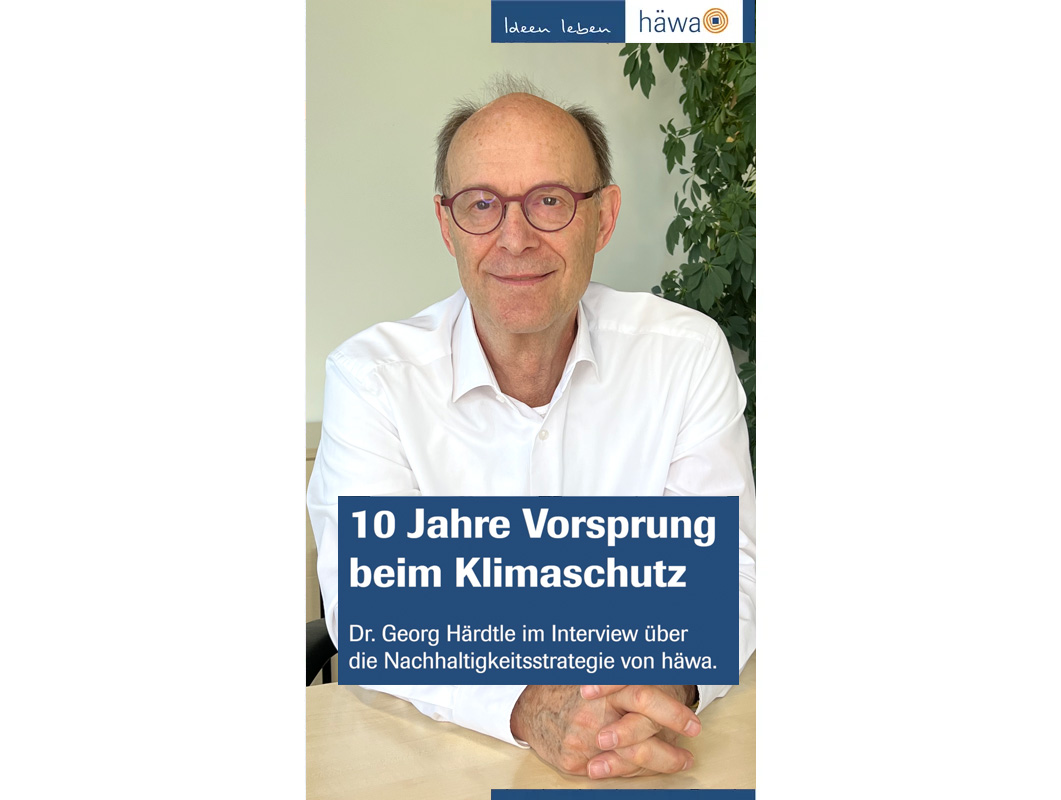
1. Dr. Härdtle, häwa has already achieved its 2035 CO₂ reduction target by the end of 2025. How was this extraordinary lead made possible?
Answer: We defined a clear climate strategy early on and implemented it consistently. The complete switch to green electricity, the expansion of our photovoltaic systems, and the replacement of fossil fuels with renewable alternatives took effect very quickly. In addition, we have gradually electrified our vehicle fleet. All these measures work together—and that is precisely what has enabled us to achieve our planned reduction target of 55% a full ten years ahead of schedule.
2. Can you briefly explain häwa’s starting point?
Answer: Yes, of course, but I’ll need to back up a bit. In a metalworking industrial company like ours, where processes such as punching, laser cutting, forming, welding, grinding, and powder coating—to name just the most important ones—are prevalent, energy demand and consumption are generally high. And high energy consumption is often associated with correspondingly high energy costs and, traditionally, with harmful emissions—so-called greenhouse gases, particularly CO2. That is why the topic of energy has actually always been a priority for us. And since the implementation of a certified energy management system in accordance with DIN ISO 50001 in 2014, energy-related issues have also become an integral part of häwa’s corporate strategy. Climate protection has—as the saying goes—to some extent become a top priority at our company.
Yes, and within the framework of this globally applicable DIN standard, we at häwa are constantly driving forward the reduction of energy consumption and, with it, the reduction of CO2 emissions from häwa. We present these, by the way, in great detail and transparently in so-called Sankey diagrams. These are flowcharts that visualize volume flows through the width of arrows. The larger the flow, the wider the arrow.
Thanks to this visualization, we—and anyone interested, since the charts are posted in our offices—know exactly where in the facility energy is being consumed and where and how much CO2 emissions have resulted from it. This transparency serves as a foundation and facilitates the targeted implementation of efficiency measures.
3. What specific goals are you pursuing to systematically reduce energy consumption and CO2 emissions?
Answer: With regard to our CO2 reduction targets, we follow the guidelines set by the federal government, specifically the Federal Climate Protection Act (KSG). It aims to achieve CO2 neutrality up to 2045; the EU has set a target of 2050, five years later.
To better monitor our progress, we have created an internal “CO₂ transformation pathway” for the emissions we can directly influence and control—primarily those in Scope 1 and Scope 2—from which interim targets and measures are derived.
We have set the year 2022 as the base year or starting point for the transformation path, beginning with a total CO₂ footprint of approximately 2.6 million kilograms of CO₂. Based on this 2.6 million kg of CO₂, we are now pursuing the goal of achieving carbon neutrality up to 2045—that is, reaching “zero.”
This means an annual CO₂ reduction of just over 4% from the baseline, or 110,000 kg.
By the end of 2025, for example, we should have achieved a 17% reduction. In fact, by the end of 2025, CO₂ emissions had already reached just over 55% of the target. This puts us 10 years ahead of the original target path and means we have far exceeded our set goal.
4. Which measures had the greatest impact on CO₂ reduction?
Answer: The biggest lever was clearly the energy supply. By completely switching to certified green electricity, we were able to immediately eliminate around 1,100 tons of CO₂ emissions. At the same time, we significantly expanded our photovoltaic installations, which allowed us to achieve a reduction of 100 tons of CO₂ there as well. Replacing fossil fuels with renewable alternatives also contributed 450 tons.
All in all, we were able to achieve a calculated reduction of around 1,600 tons of CO₂ within four years.
5. How do you view this success strategically? Is this an endpoint or an intermediate step?
Answer: No, not an endpoint! For us, what we have achieved so far is an important milestone in our climate strategy, but clearly not an endpoint. We see this head start more as additional leeway that gives us time to solidly prepare further steps. In addition, we want to use the momentum we’ve built to tackle one or two projects with even greater ambition. This success confirms we’re on the right track—and motivates us to keep going.
6. What are häwa’s next steps on the path to climate neutrality by 2045?
Answer: Well, we will continue the steps we have already begun and further increase our energy efficiency. In particular, we will analyze and optimize our processes—from production and logistics up to building services and heat and energy supply. We will develop additional photovoltaic areas, further substitute fossil fuels, and also drive forward the electrification of our vehicle fleet.
Our goal is to minimize the remaining emissions step by step before we may eventually have to offset unavoidable residual emissions in the long term by purchasing credits.
In addition, there is a point I haven’t mentioned yet, but which we also want to partially incorporate into our climate strategy. These are the Scope 3 emissions that we intend to track, calculate, and analyze. Scope 3 emissions are those occurring upstream and downstream of our value chain and are the responsibility of suppliers or end-users. Examples include purchased goods and services, upstream transport and distribution processes, as well as waste disposal.
Although these emissions are not covered by the Federal Climate Protection Act and therefore do not affect our transformation path, they are increasingly required by EU directives as part of corporate sustainability reporting obligations and thus indirectly also by us as a supplier if we are part of their supply chain.
7. What role do the construction of the new administration building and the new paint shop play in this context?
Answer: From a structural engineering perspective, the administrative building and the new coating facility form a single, interconnected building complex. This building complex is also a key component of our climate strategy. The new construction enables us to utilize modern, energy-efficient building technology and rethink our processes. We are deliberately using these investments to combine economic and environmental goals. We have built the complex to the KFW 40 standard, which means that this building requires only 40% of the energy needed by comparable standard buildings. With regard to plant technology, for example, we have converted the hot-water-fed pretreatment system of the PBA from gas-fired to biomass-based and thus CO2-neutral local heating. Current energy efficiency calculations for the new powder coating plant with patented heat recovery assume an energy requirement that is approximately 25% lower than that of the old plant.
8. How are customers and partners reacting to the rapid progress?
Answer: The response from customers and partners has been very positive, from what we’ve heard. This is because many of our customers are increasingly focused on the sustainability of their supply chain, and to our customers, we are part of their supply chain.
The fact that we’ve been able to reduce our emissions so significantly builds trust and shows that we’re taking responsibility.
Yes, and internally we’re also feeling a high level of motivation—and I want to emphasize this point: this success is a shared one, because the work leading up to it was a shared effort as well. – Thanks to everyone who feels this applies to them.
9. What is the most important aspect of this success for you personally?
Answer: For me, the key is that we’re demonstrating: climate protection is achievable if you approach it strategically and implement it consistently. We’ve proven that ambitious goals are attainable—and that they can be combined with economic rationality. I think that’s a strong signal for our company—and also a strong signal for the entire industry.